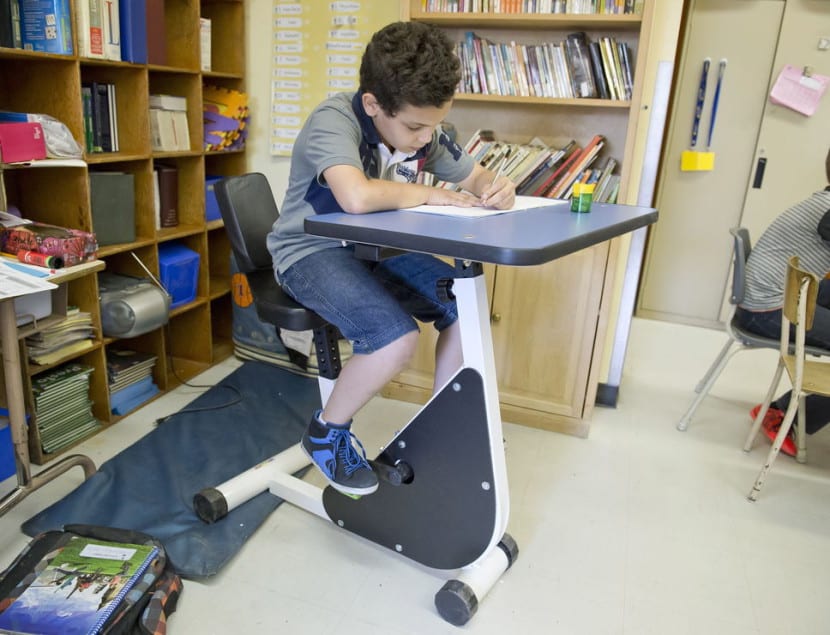
I still can't hide my amazement at this "invention" for children with hyperactivity issues. The goal is to control the energy that a hyperactive child has in the classroom; this energy is what many pharmaceutical companies try to medicate to make children calmer. However, this chair emerged in a school in Canada, and its strategy is not to use medication but to tire them out with movement.
Therefore, they designed this bike desk so that hyperactive children do not want to get up from their seats and can tire themselves out with their attention. Thus, more active children can exercise while participating in class, reducing their desire to get up from their desks when they feel more comfortable.
What is a Bike Desk?
In educational institutions in different countries, an application known as bicibanks or bicipupitres has started to be used: a school desk combined with fixed bike pedals. This combination allows students to continuously pedal while sitting in class, thus integrating physical activity into their academic days.
The main idea behind these bicibanks is to enhance the ability to focus while also maintaining children's physical health. By providing a more dynamic and less rigid environment, it aims to facilitate the learning of students who require more movement.
This pupitres has emerged from the need to adapt teaching methods to the new realities in the classroom, especially for students who struggle to maintain their attention or have high motor restlessness. Instead of forcing them to remain still, it is suggested that they channel their energy while following the class.
The Canadian School and the Situation of Mario Leroux
The teachers at this school (especially a teacher named Mario Leroux, who is explaining to Le Journal de Montréal) state that one of the biggest problems in classrooms is hyperactive children. A mother, a psychopedagogue, and therapeutic pedagogue, cannot help but feel discomfort at these words because my view is that hyperactive children will never be the source of a problem. The issue lies in showing little tolerance or understanding towards the needs of these children.
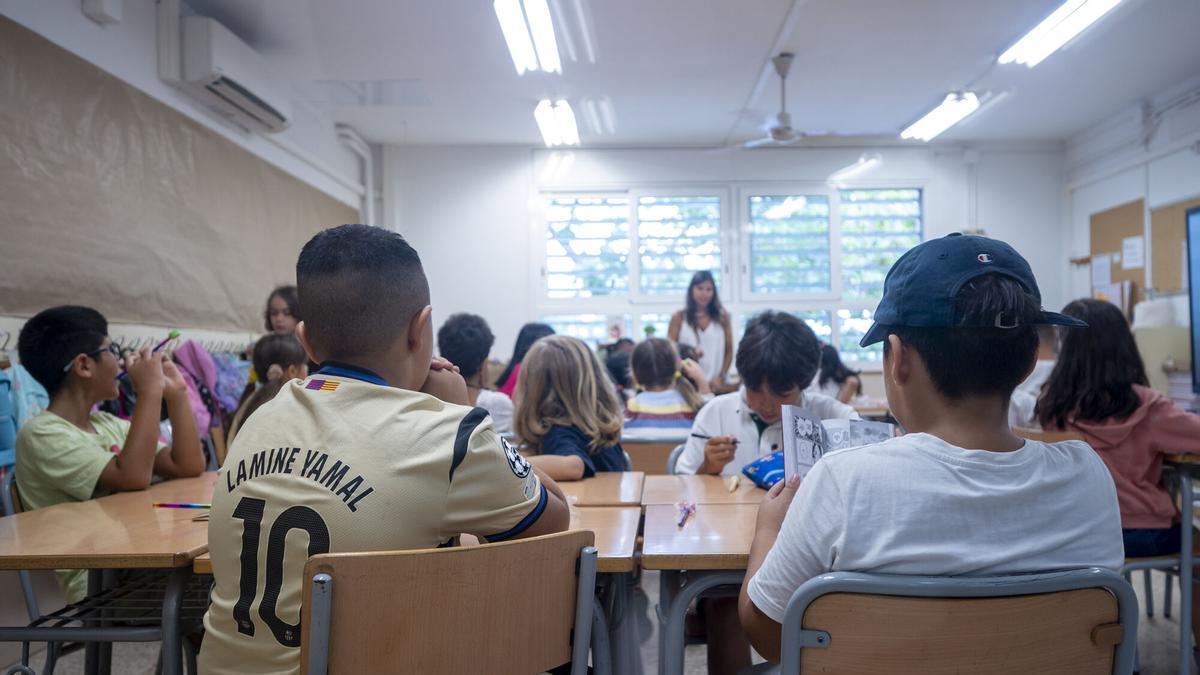
At the Des Cèdres school in Laval (Quebec), several bicipupitres have been installed for students who need more movement to be able to pedal during lessons. Teachers using this desk explain that after continuously pedaling, the children appear more relaxed, make fewer interruptions, and adapt better to the class dynamics.
From a medical perspective, some experts indicate that motor activities (like pedaling) can enhance certain cognitive skills, particularly executive functions related to planning, organization, and emotional regulation. This is one of the reasons why the project receives community support; it is seen as an alternative to medication in certain situations.
What is ADHD and Hyperactivity in Children?
"Hyperactive" or "attention deficit" children are primarily children and what they need is for the education system to adapt to their needs and teach what they need to learn according to their identity; this is something that should be done for all children. They do not need a bike to pedal for 15 minutes and get tired. Personally, I believe that a tired child will not be able to focus; they will only seek a way to rest.
Attention Deficit Hyperactivity Disorder (ADHD) is considered a neurodevelopmental disorder that is seen during childhood and, in many cases, also in adolescence and adulthood. It is typically characterized by three main symptom groups: inattention, hyperactivity, and impulsivity. These traits can make situations like maintaining continuous concentration, following instructions, completing tasks, or sitting still for long periods challenging.
Hyperactivity means a higher level of physical activity than expected for the child's age; it manifests as constant movement, frequent changes in position, or a need to get up. Impulsivity can manifest as interrupting others, acting without considering the consequences, or having difficulty waiting in line.
The exact causes of ADHD are not fully understood, but it is thought to be a combination of genetic, environmental factors and differences in the structure and function of the brain. Diagnosis and treatment often require a multidisciplinary approach involving pediatricians, psychologists, neurologists, and school counselors.
Bicycle Desks, Movement, and Attention: Possible Benefits and Limitations
Proponents of bicycle desks believe that these devices are particularly beneficial for students with ADHD because they allow for the integration of physical movement into school activities, eliminating the need for the child to leave the classroom. In this way, they can channel their excess energy and reduce behavioral issues.
The constant movement of the pedals provides a way to release pent-up energy; this can translate into emotional regulation and ease of listening for some children. Various studies have shown that physical activity enhances certain executive functions of the brain; this could theoretically support planning and organization in an academic context.
Additionally, bicycle desks are presented as a resource to provide a more inclusive and flexible education. Instead of stigmatizing movement, they are integrated naturally into the classroom dynamics, normalizing the need for some children to have more motor activity to learn.
However, as a teacher and a parent, I believe it is important to remember that there is no one-size-fits-all solution for every child. While some may benefit from such a desk, others may feel even more tired or distracted. A tired child does not learn better; they need rest, understanding, and adults who respect their time and rhythms.
International Experiences with Bicycle Desks
The idea of combining movement and learning is not limited to a school in Canada. Experiments have also been conducted in other countries with bicycle desks and classrooms equipped with stationary bikes.
For example, in some middle school centers, dozens of bicycle desks have been set up so that first-term students can pedal while engaging in academic activities. According to management teams, families and students have welcomed this initiative, and positive changes in the energy and academic performance of certain groups have been observed.
In other projects, advanced students have designed their own versions of these bicycle desks specifically for their ADHD peers as part of science, technology, and ethics classes. They note that this resource could be very beneficial for certain situations within the wide spectrum of the disorder, but it is not always the ideal option because each individual has different learning patterns.
There are also programs that create special classes where traditional desks are replaced with stationary bikes; thus, children can pedal while doing specific exercises or reading. In these experiences, an increase in reading motivation and improvements in certain academic indicators like reading comprehension have been observed.
The Importance of Adults and the Education System
However, the opinion or invention of this man regarding this interesting arrangement is not the worst; what concerns me more is the social support he receives. I am not a pediatrician, but my teaching experience shows that a child does not need to engage in sports to participate in class; they need adults who guide them in their learning; this varies depending on the child's needs.
A resource like a bike seat can be a complementary tool within a much broader approach; this should include methodological adaptations, emotional support, working on social skills, and collaboration with families. If this is used in a way that replaces these, there is a risk of blaming the child's nature.
Children exhibiting ADHD or very active behaviors need clear structures, respectful boundaries, rest periods, and environments where movement is considered a natural part of their development. Additionally, educators who understand what ADHD is, have realistic expectations, and adapt activities to ensure their successful participation are necessary.
In this context, any initiative involving movement in the classroom requires deep consideration of what kind of school we want and how much we embrace diversity. Adding new furniture, no matter how eye-catching, is not enough; it is essential to transform perspectives, practices, and discourses so that no child is seen as a "problem."
What do you think about this? Beyond the curiosity created by these bike seats, what truly matters is to remember that every child, whether they have ADHD or not, needs a understanding, flexible, and respectful school environment; here, movement should be a possibility, but it should never be the only answer or a new labeling method.






































Comments
(8 Comments)