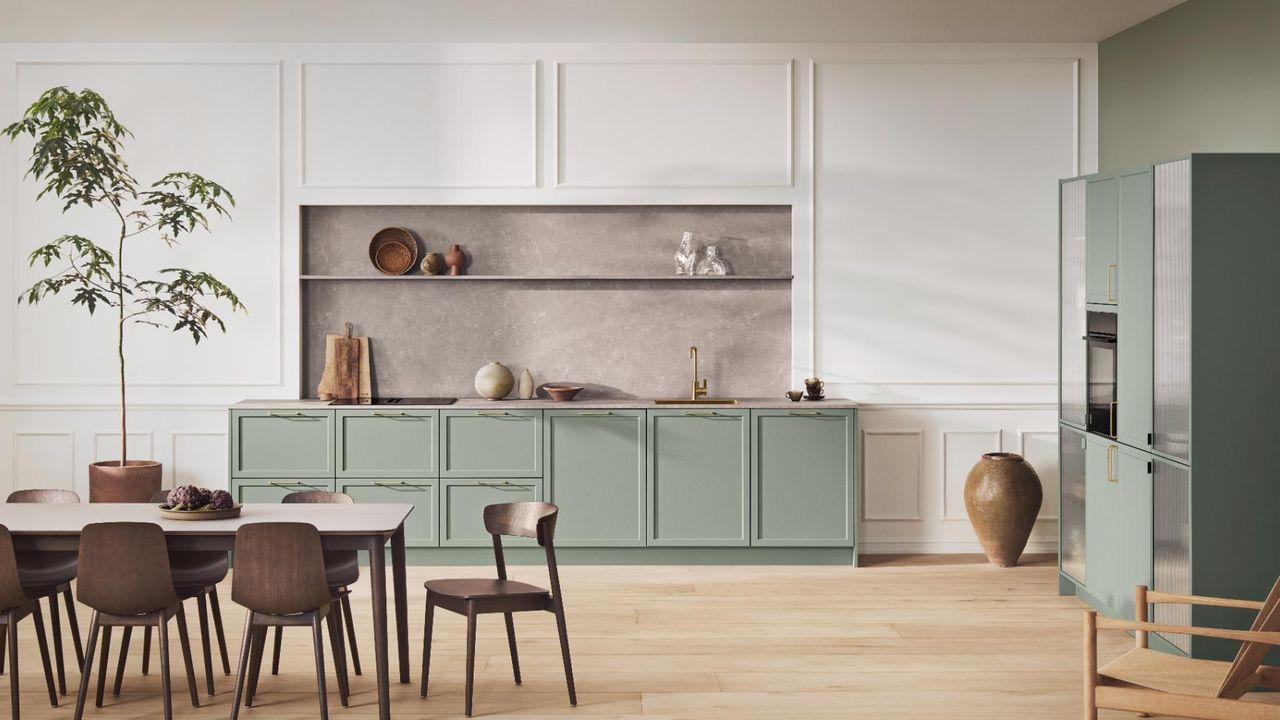
Kitchens have evolved from being just a workspace to becoming the true social and emotional center of the home. Here, meals are prepared, remote work is done, homework is completed, friends are entertained, and even video calls are made at the stove. Therefore, the kitchen trends of this season focus on designing beautiful, efficient, and human-centric spaces that go beyond basic functionality.
This year, open or semi-open kitchens filled with vibrant colors, equipped with invisible technology, and increasingly made from sustainable materials are coming to the forefront. Colors are deepening, brightness is returning, wood is taking center stage, and islands are becoming a major meeting point between the workspace and the living room. If you are considering renovating or redesigning your kitchen, a comprehensive guide containing all the keys that will define this season is waiting for you here.
Trending Colors in Kitchens: From Green to Burgundy and Earth Tones
As a major hero, intense greens inspired by the richness of nature, as well as softer and dustier tones of olive, moss, or sage are standing out. This color pairs perfectly with wood, stone countertops, and more vibrant tones like orange or mustard.
In addition to green, burgundy or cherry red is also making a strong appearance. This bright garnet adds a sophisticated and somewhat theatrical air to kitchen furniture. It's perfect for updating classic-cut furniture and provides a significant advantage when combined with cream, mink, or warm beige tones.
Additionally, earth and chocolate tones are on the rise: warm beiges, sand, clay, gray, and even brown tones reminiscent of chocolate or milky coffee like Mocha Mousse. These colors enhance a sense of sanctuary and integrate perfectly for homes seeking warmth and comfort.
In parallel, dark colors such as forest green, navy blue, and matte black continue to be strong, especially in two-tone combinations with light wood or cashmere tones. They are used in cabinets, islands, or panelized white appliances to add depth and a very contemporary touch.
Finishes: The End of High Gloss, Lacquered, and All-White Kitchens
Interior design experts agree: completely white and flat kitchens are losing their significance. They won't disappear, but they are now reserved for specific projects. The dominant trend is leaning towards color combinations and especially high-gloss finishes.
Glossy lacquer finishes are becoming a major tool for introducing intense colors without overwhelming. They are used on green, burgundy, or petrol blue cabinet fronts, giving the kitchen a jewel-like quality, almost like a design piece. Many designers are resorting to techniques similar to automotive painting to achieve the perfect finish.
High gloss is not limited to furniture: it's also seen on satin-painted walls, lacquered kitchen fronts, and some countertops or decorative panels. These types of finishes reflect light and create a more luxurious and theatrical atmosphere, especially in kitchens that open to the living room.
Alongside the explosion of gloss, cashmere, warm beiges, and gray are emerging as the new whites. They are soft, chic, and much more durable in terms of hiding stains; this is a critical factor for those who want a highly used but always flawless kitchen.
As a result, there is a search for a kitchen that combines color depth and a sense of visual cleanliness: flat fronts, a minimal number of visible handles, and carefully selected colors that integrate with the rest of the home.
Featured Materials: Porcelain, Sintered Stone, Wood, and Bold Mixes
The most important aspect defining today's kitchens is investments in highly durable and natural-looking materials. Countertops, floors, and fronts must withstand intense use without compromising on design.
Porcelain materials and sintered stones are becoming great favorites for countertops, vertical cladding, and even furniture fronts. These materials, obtained by exposing natural mineral and clay mixtures to high pressure and very high temperatures, offer surfaces that are extremely resistant to stains, scratches, and high temperatures, nearly non-porous, and very easy to clean.
Expert brands offer porcelains that mimic marble, granite, concrete, or wood with great realism and feature impressive veins and textures. Models inspired by black marble, gray stone carrying an Iranian vibe, or flat stone blocks create particularly sculptural kitchens, especially in large format islands.
Wood is gaining strength as the main material for fronts and furniture, but with a more contemporary aesthetic, closer to modern design than traditional rustic. Light-toned oak, natural walnut, framed fronts providing visual rhythm, and textures that can be felt when touched are emerging.
Additionally, an eclectic mix of materials is also highly preferred: they are not hesitant to combine natural stones with brick, aged metal, warm woods, and colorful quartz countertops. The key lies in mixing textures and finishes, as in professional kitchens, but adapting them to the home environment.
New Forms of Distribution and Kitchen Use
Experiences from recent years have reinforced the kitchen as the multifunctional heart of the home. Here, meals are eaten, work is done, conversations are held, and time is spent with family. This new way of using space completely changes the traditional distribution.
The classic work triangle between the sink, stove, and refrigerator is no longer sufficient. In many homes, multiple people are cooking at the same time, thus increasing functional areas: preparation corners, special areas for coffee, spaces designed for cooking or baking in vacuum, and sinks with integrated workstations.
Islands are becoming more prominent, turning into a real living center. They are used for food preparation, having breakfast, working on a laptop, or enjoying drinks with friends while someone cooks. Often, they establish a visual and functional connection with the living room or dining room, especially in open-plan homes.
Alongside completely open kitchens to the living room, half-open kitchens with sliding doors are also on the rise. This allows for closing off the space while cooking intensively (to control smells and noise) and opening it up when more connection is desired. The doors can be made of glass, wood, metal frames, or combinations that add an architectural touch.
Additionally, the laundry room is being re-evaluated as a standalone area, with well-designed, good storage space and decorative solutions. It is transforming from a forgotten corner into an integrated part of the main home project, using similar materials to the main kitchen.
Cupboards, Shelves, and Smart Storage
Aesthetically, the dominant line in furniture is clear: flat, minimal, and well-organized cupboards. Rectangular doors, embellishments, and large decorations lose their weight alongside simple and contemporary fronts.
European-style cupboards are becoming more common with simple designs and handle-less or opening systems. Appliances are panelized to disappear behind the doors, providing a uniform appearance, especially in kitchens integrated into the living room.
The interior is becoming (in a good way) more complex: cupboards with dividers, smart corner furniture, drawers, and sliding columns allow for the optimization of every space. The goal is that nothing is lost at the back, and everything is accessible and visible.
Another clear trend is to give up some tall furniture in favor of open shelves or visible shelves. This lightens the visual weight of the kitchen and leaves space to display special plates, cookbooks, or small decorative items. In many cases, these shelves are illuminated with integrated LED strips to highlight the contents.
Transparent glass door display cabinets continue to exist and bring back the spirit of old cabinets with a modern aesthetic. They are a perfect place to showcase old dinnerware, inherited plates, or pieces with emotional value.
Electrical Appliances: Efficiency, Color, and Nearly Invisible Technology
This season's kitchen is unthinkable without modern, connected, and efficient electrical appliances. The aim is to reduce energy consumption, enhance safety, and make the user's life easier.
Major brands are offering AI-based smart equipment; these devices can optimize programs, detect washing loads, adjust cooking temperatures, or even suggest recipes. They are also used to monitor consumption and manage devices from mobile devices by integrating into connected home ecosystems.
Induction stands out as the preferred cooking system and increasingly, the invisible integrated induction system on the cooktop leaves the surface completely clean when not in use. This provides a very continuous and minimal aesthetic, especially in open kitchens.
In the aesthetics of electrical appliances, there is a sense of fatigue against traditional stainless steel. Although still present, there is a growing demand for cooktops, refrigerators, and hoods in striking colors or those that completely blend with furniture. The "industrial kitchen" concept makes room for the idea of a thoughtfully designed kitchen.
Sustainability is reinforced by electrical appliances with high energy efficiency ratings, water control systems in dishwashers and faucets; furthermore, it is supported by smart solutions that adapt lighting and consumption to the moment of each day.
Lighting: Well-being, Design, and Biodynamic Technology
The light in the kitchen is no longer just considered a functional element. Now, lighting designed to support well-being, mood, and the aesthetics of the space is being created. The similarity to a film set is not random: light changes everything.
Multiple levels are brought together: recessed general lighting (ceiling spots, tracks), special lights above work areas (under high furniture, over the island), and decorative points function as standout pieces like accent lights or pendant lamps.
There is now more discussion about biodynamic lighting; this is lighting that changes color temperature and intensity throughout the day and accompanies our biorhythms. In the mornings, cooler and stronger lights that encourage activity are preferred; in the evenings, warm and adjustable tones that invite relaxation and socialization are favored.
Integrated LED strips on shelves, display cases, or sockets create very intimate environments, highlight special materials (such as veined marble or textured wood), and increase visibility without resorting to aggressive lighting.
A recurring detail among designers is the use of intensity adjusters in almost all lighting. This allows the kitchen to transform in seconds: from a clean laboratory for cooking to an intimate and warm space for dinner.
Sustainability, Water Conservation, and Environmental Responsibility
The kitchen furniture industry is increasingly committed to sustainability, ecological design, and circular economy. This is not a temporary trend, but a line of work that affects materials, production processes, and final products.
Manufacturers are working to reduce carbon footprints, increase the use of recycled or recyclable components, and offer solutions with lower environmental impact: from forest-certified panels to less polluting coatings or more responsible packaging.
In daily life, sustainability is reflected in details such as low-consumption smart faucets; these are equipped with aerators that reduce water flow and offer opening mechanisms that control water flow without reducing pressure or thermostatic systems that instantly adjust temperature.
Additionally, high energy efficiency electrical appliances are devices that can significantly reduce electricity consumption and, in some cases, optimize resource use through sensors and automatic programs. Some technological solutions promise significant consumption reductions throughout the year.
All of this comes with a clear preference for durable and easy-to-maintain materials; these materials should not need to be replaced within a few years. The goal is to make a long-lasting kitchen investment and adapt the kitchen to new phases without starting from scratch, with small decorative changes.
Decorative Styles: Mediterranean, Industrial, Retro, and Designer Kitchens
Aesthetically, this season's kitchen opens up to various styles that are often combined with each other. One of the strongest is the Mediterranean style; this style uses light colors (white, beige, nude), plenty of natural light, plant fibers, and raw woods.
In these Mediterranean kitchens, it is common to see textured walls, light stone countertops, terracotta floors, and furniture that has a handmade feel. Everything gives a sense of endless summer and a relaxed coastal living, even if they are in the city.
The industrial style is still very present; especially among those seeking character. It is supported by details such as strong contrasts between metal, black and gray tones, dark tones with light countertops, and visible structures or prominent handles. However, it is now softened by combining warm lighting and wooden elements.
As a nod to the past, there are also retro and vintage kitchens inspired by grandmother's kitchens: appliances with rounded shapes, pastel colors like pink or light blue, reclaimed cabinets and display cases to showcase old dinnerware. This is a style that has a very intimate, nostalgic, and emotional value.
And in the most exclusive part of the market, designer kitchens created by major fashion brands or industrial design studios are emerging. These are projects designed with curved forms, very creative solutions, and often an element of futurism that turns the kitchen into a true collector's piece.
Looking Ahead to 2026: Invisible Technology, Craftsmanship, and Emotional Design
Looking a bit further ahead, kitchens are starting to lean more towards hidden technology and sensory design. Electrical appliances are visually disappearing, furniture fronts are being panelized and combined, and the priority is given to valuable materials, textures, and small handmade details.
Open wood with visible grains, framed fronts, veined marbles, and fine metals are combined with walls that have the appearance of plaster, micro-concrete, or clay; these walls can also be reproduced with high-quality vinyl and wallpapers without requiring construction.
Great value is placed on personalization with handmade elements: imperfect ceramics, handles designed by artisans, natural textiles, or decorative wall paintings that turn a wall into a canvas. Even the ceiling becomes a prominent surface that is painted or covered to attract attention.
On the other hand, spatial design is also evolving; enabling enjoyment outdoors in connection with more open kitchens, terraces, or courtyards, and laundry rooms are considered small wellness areas. The kitchen is reinforced as a place not just for cooking, but for living.
As a whole, all these trends paint a picture of the kitchen as a functional, sustainable, technologically advanced, and deeply decorative space. A place that tells the story of its inhabitants and adapts to the true lifestyle of the home; placing experience and comfort ahead of catalog images.








































Comments
(7 Comments)